

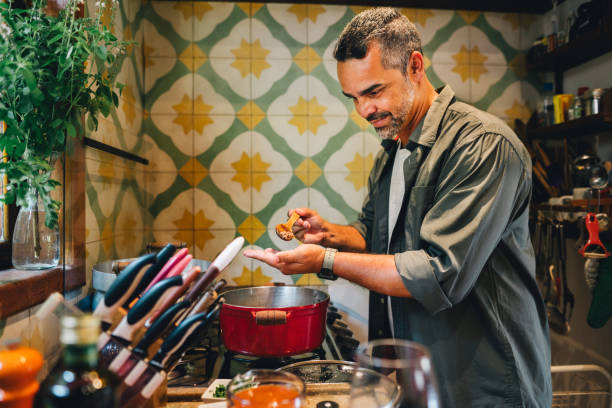
Take mixing verbs first. Stir, mix, whisk, beat, and fold all sound similar, but they ask for different levels of energy and different results. Stirring is gentle. You’re combining ingredients until they’re blended, often with a spoon or spatula. Mixing is broader and can mean anything from tossing a salad to combining dry ingredients. Whisking brings air into liquids, like eggs or cream, using a wire whisk in quick, circular motions. Beating is more vigorous and builds structure and smoothness. Folding is the delicate one. You add a light mixture, such as whipped cream or beaten egg whites, into a heavier one without knocking out the air. Use a spatula, cut down through the center, sweep across the bottom, and turn the mixture over. Repeat gently. If you stir too hard, you’ll deflate it, and your pancakes or soufflé will be flatter than you’d like.
Prep words are another common stumbling block. Chop, dice, mince, and julienne describe size and shape. Chopped pieces are irregular and bite-sized. Diced pieces are neat cubes, usually smaller. Mince means very fine, almost crumbly, which is why recipes call for minced garlic or ginger. Julienne means thin matchsticks, often used for stir-fries or salads. These distinctions matter because smaller pieces cook faster and distribute flavor more evenly. If a recipe says minced onion and you leave big chunks, your sauce may taste uneven. If it says julienne carrots and you chop them, the texture changes. You don’t need perfect knife skills, but aiming for the described size helps the dish behave as intended.
Heat terms can be equally confusing. Searing and browning are not the same as cooking all the way through. Searing uses high heat to create a flavorful crust on meat or vegetables. Browning is similar, but it’s more about developing color and deep flavor. Simmering means small bubbles break gently at the surface, while boiling means vigorous bubbles and lots of movement. Braising means cooking food slowly in a covered pot with a little liquid, often after browning. Deglazing is the magic trick that follows searing: you pour a splash of wine, broth, or vinegar into the hot pan and scrape up the browned bits. Those bits are packed with flavor, and deglazing turns them into a quick sauce. Reducing means simmering a liquid until it thickens and concentrates, which is why a recipe might say “reduce by half.“ You’re not losing flavor; you’re making it stronger.
Then there are the sensory cues that recipes use as checkpoints. “Cook until fragrant” usually means about thirty seconds to a minute for spices, just until they smell warm and toasty. “Until translucent” means onions have softened and turned see-through, not browned. “Until golden” means a shade of brown that signals browning and flavor, not necessarily deep brown. “Until it coats the back of a spoon” describes a sauce thick enough to leave a thin film. These phrases can feel vague, but they’re invitations to use your senses. Recipes can’t know your stove, your pan, or your ingredients, so they teach you what to look, smell, and feel for.
The best way to master recipe jargon is to read the whole recipe before you start. When you hit an unfamiliar term, pause and look it up. A short video can make “fold” or “deglaze” click in seconds. Then practice. The more you fold, sear, and simmer, the more intuitive the language becomes.
Eventually, those cryptic words stop feeling like rules and start feeling like tools. Recipe jargon isn’t a barrier; it’s a shared language that helps dinners come together with more flavor, better texture, and less stress. Once you can decode it, you can cook with more freedom—and that’s a goal worth setting at any table.