

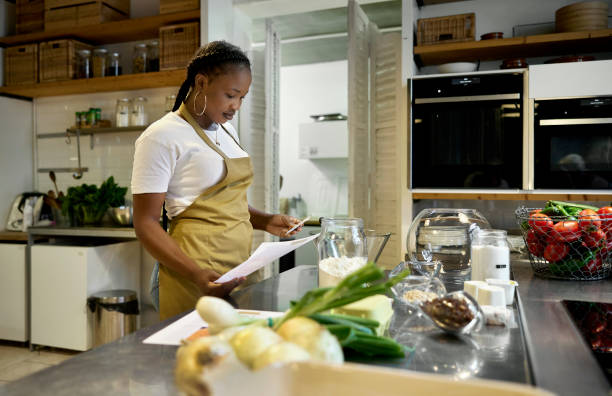
The first step is to find the recipe’s basic yield and decide your multiplier. If a recipe serves four and you need six, multiply by one and a half. If you need twelve, multiply by three. That works beautifully for chopped vegetables, beans, canned tomatoes, and broth. It works less perfectly for salt, spices, thickeners, and anything that browns. Think of the multiplier as a starting point, not a rule carved into the kitchen table.
Salt is the ingredient most likely to betray you. Doubling a recipe does not always mean doubling the salt, especially if you are also doubling salty ingredients like soy sauce, olives, capers, or Parmesan. Start with about one and a half times the salt when doubling a savory dish, then taste at the end. The same goes for cayenne, chili powder, and other hot spices. They can become more intense as a large pot simmers and concentrates. You can always add more heat, but you cannot take it out.
Aromatics like onion, garlic, and ginger are friendlier, but they still need space. If you double the onions in a skillet, they may steam instead of caramelize because the pan is crowded. Use a wider pan, a larger Dutch oven, or cook them in batches. Browning is not just about color. It builds the deep flavor that makes a scaled-up dinner taste just as good as the original. The same rule applies to meat. If you are browning beef for chili or chicken for a casserole, give the pieces room. A crowded pan creates steam and gray meat, while a spacious pan creates the golden edges everyone wants.
Liquids behave differently in bigger batches. A large pot has less surface area relative to its volume, so evaporation slows down. If you triple the broth in a stew, you may end up with soup instead of a rich braise. Start with less liquid than the math suggests, then add more as it cooks. For sauces, you can reduce them separately in a wide skillet before adding them back. That gives you control without overcooking the main ingredients.
Pan size matters as much as ingredient math. Doubling a casserole in one deep dish can leave the center watery while the edges dry out. Two smaller dishes usually cook more evenly than one giant one. If you only have one large pan, expect a longer bake and check the middle with a thermometer or a knife. For roasted vegetables, use two sheet pans instead of piling everything on one. For pasta, cook the noodles in batches so they do not stick together, then toss them with the scaled sauce. For grains, keep the same water-to-grain ratio, but use a pot large enough for the grains to swell.
Some dinners scale more gracefully than others. Soups, stews, chili, pulled meat, taco fillings, pasta bakes, and tray bakes are forgiving. They welcome extra vegetables, beans, or broth. Delicate sauces, fried foods, and precise baked goods require more caution. If you are feeding a crowd, choose a recipe that can be made in stages. Cook a big base, then set out toppings so everyone can customize. A pot of shredded chicken can become tacos, rice bowls, or salads. A batch of marinara can cover pasta one night and become a baked ziti the next.
Scaling down works the same way in reverse. Halve the main ingredients, use a smaller pan, and shorten the cooking time. Taste sooner. If a recipe calls for one egg and you need half, beat it and use half by weight. For busy households, the real goal is not perfect math. It is flexibility. When you understand which parts of a recipe stretch and which parts need a gentle hand, you can feed two, six, or twelve without losing the flavor that made dinner worth planning in the first place.